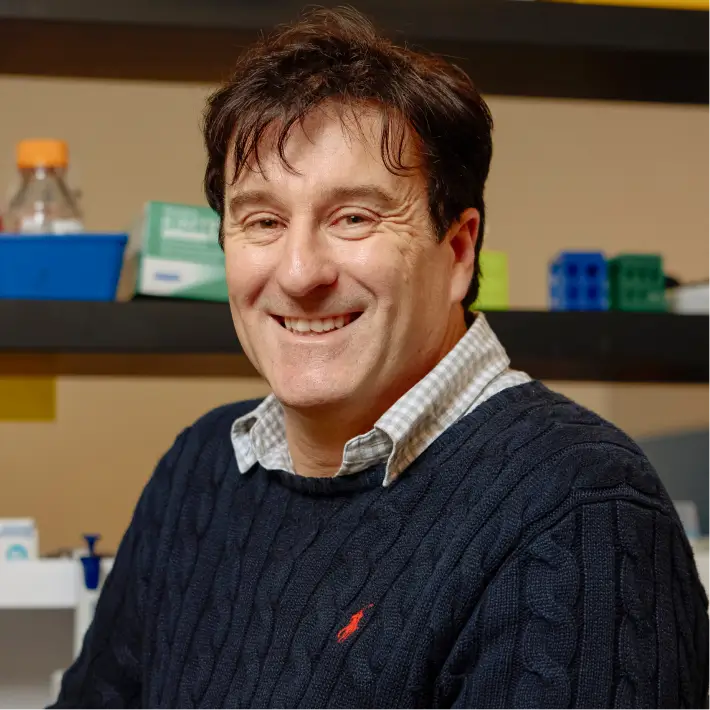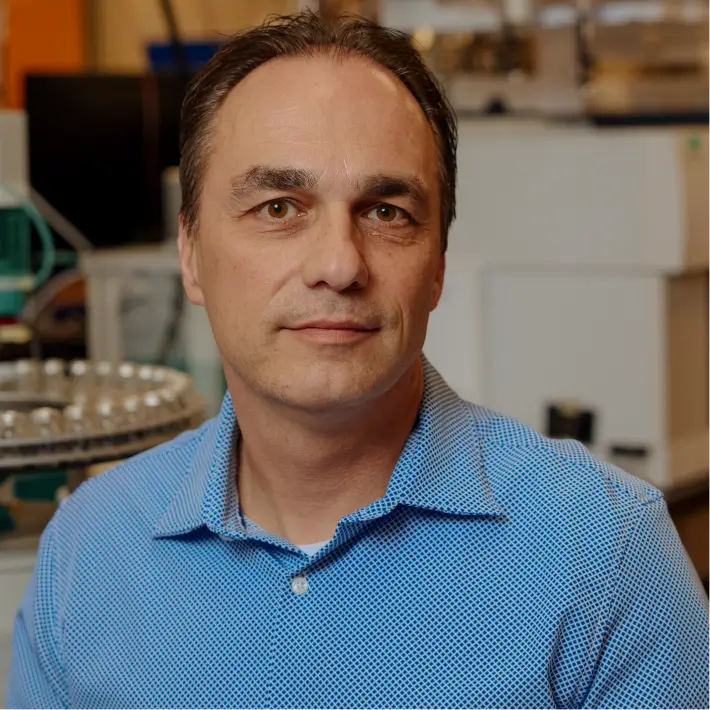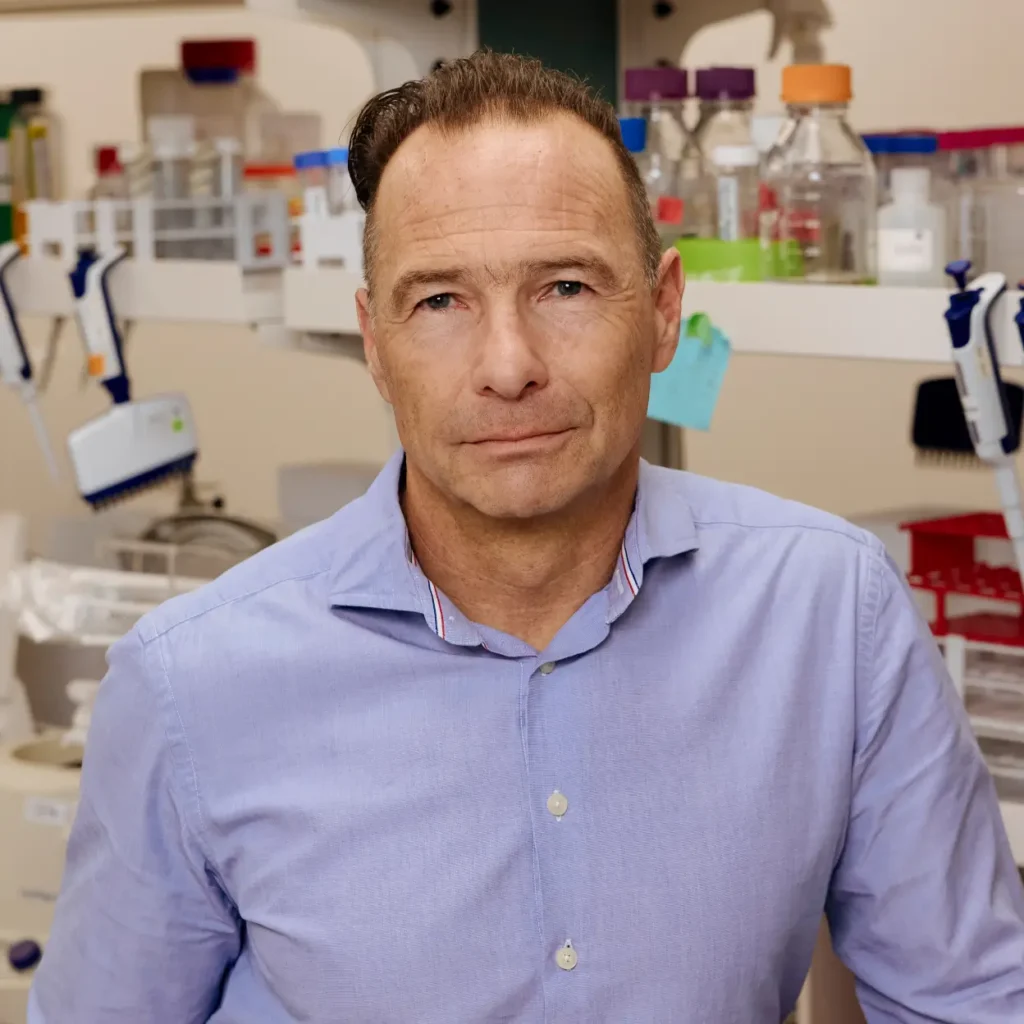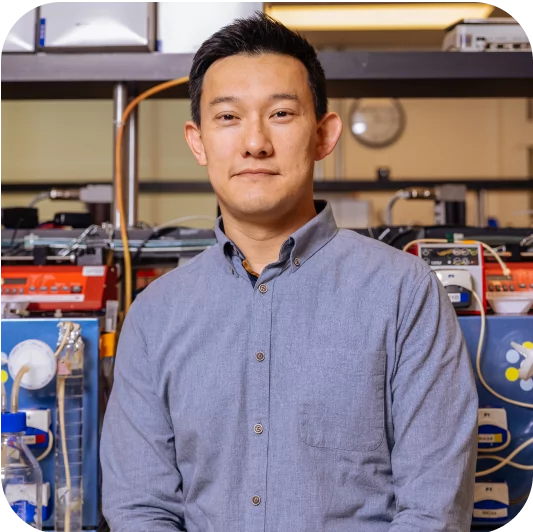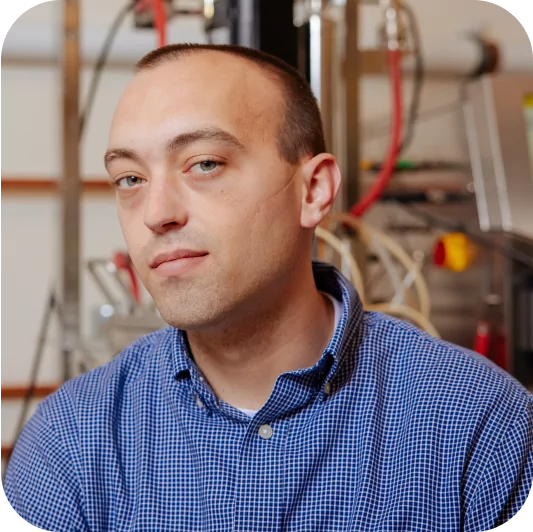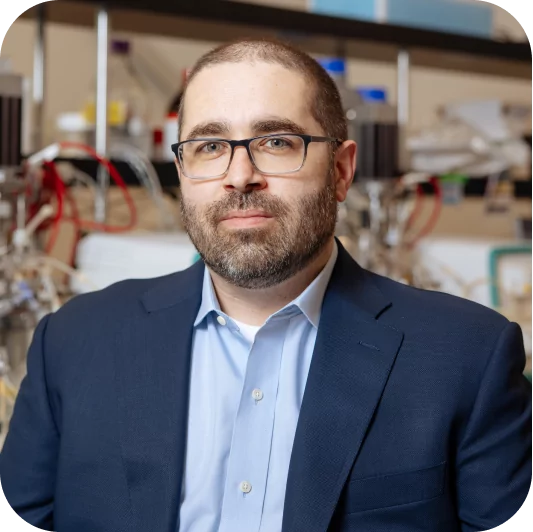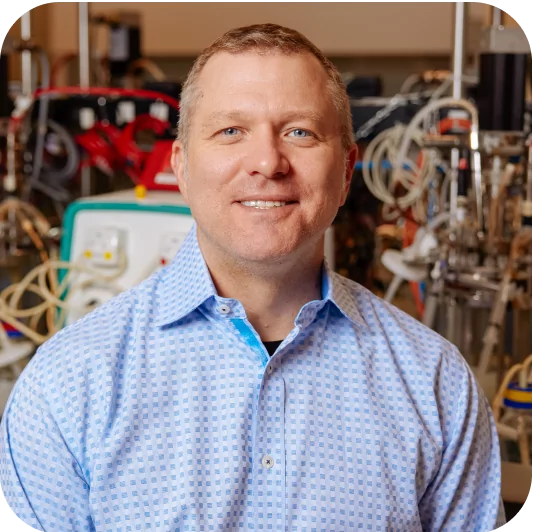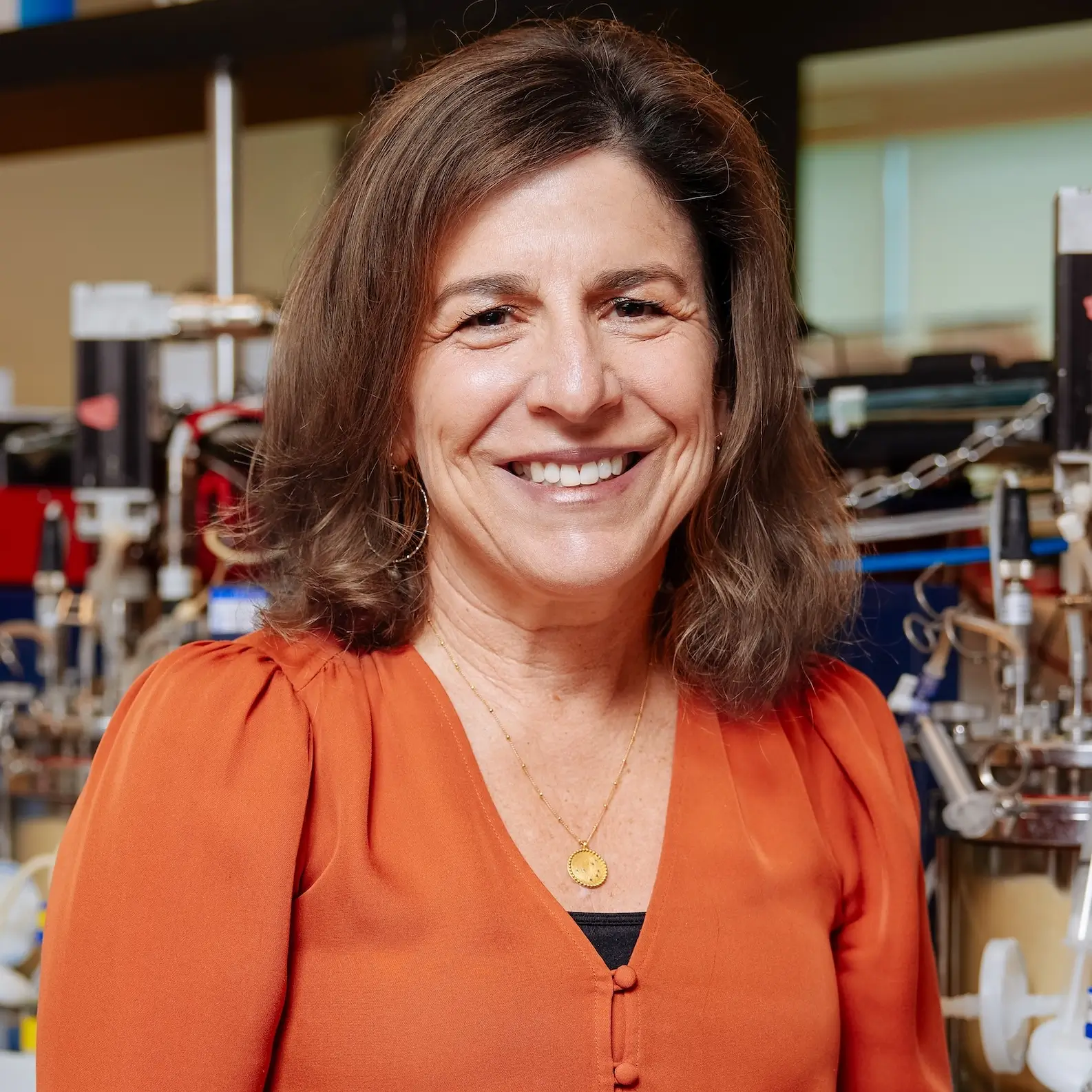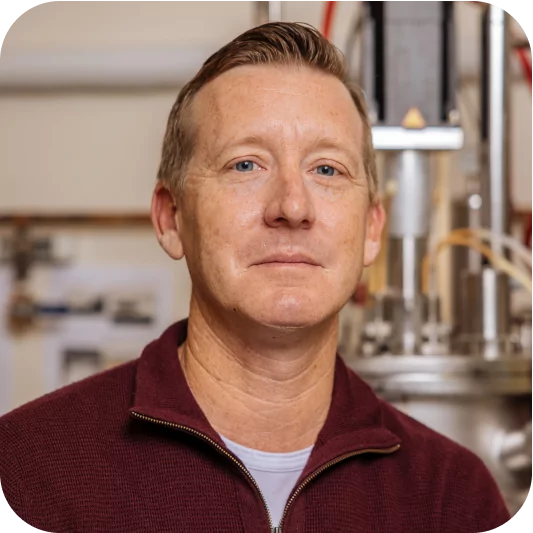
In today’s blog, we are pleased to introduce Stefan Bauer, Senior Director, Analytical Development. Stefan brings nearly two decades of analytical chemistry expertise to Antheia, with a career that took him from food chemistry in Germany to leading high-performing labs across the U.S. biotech industry. We sat down with Stefan to learn about his journey to Antheia, how he balances hands-on lab work with leading a team, and his goals for the year ahead.
Tell us about your background and career journey. You started out in food chemistry in Germany before moving into biotech in the U.S. What drew you to this field, and how did that early training shape your approach to analytical chemistry?
Food chemistry in Germany is essentially analytical chemistry. It covers everything food-related, but also consumer goods like clothing and toys. In principle, it’s anything that comes into contact with the human body, except pharmaceuticals, which is its own field. The core question is always the same: what components or chemicals are present, and in what quantity? I was exposed to a wide range of analytical techniques designed to answer that question. Unlike other branches of chemistry, it’s a field that friends and family could actually relate to and understand.
My path to becoming a state-certified food chemist included training at a state lab, which also covered food law. While I was there, a new lab was built out for meat profiling and authentication, which is accomplished through DNA testing, a method I hadn’t worked with before. It opened my eyes to a new way of solving analytical problems.
I wanted to deepen my knowledge of molecular biology and understand the possibilities of this newer technology, which led me to a postdoc at Stanford where I learned PCR, sequencing, DNA analysis, cloning, and protein expression. I combined those skills with analytical techniques to characterize an enzymatic toolkit for analyzing plant cell wall carbohydrates.
This brought me to the Energy Biosciences Institute at Berkeley, which focused on generating biofuels through strain engineering and chemical catalysis. They needed a core analytical facility manager who understood the chemistry and could speak the language of the molecular biology team. That was my entry point into biotech.
From there, I moved into a series of fermentation-focused biotech startups, including Zymergen, where I spent seven years building out and leading the R&D analytical chemistry side of the high-throughput strain screening platform. Those experiences allowed me to apply my analytical background to everything from engineered microbial strains to alternative proteins. In hindsight, analyzing complex food matrices had uniquely prepared me for analyzing complex biotech samples like fermentation broth. Many food products are themselves fermentation-derived, so the shift felt less like a deviation and more like a natural continuation. I simply enjoy applying chromatography and mass spectrometry. Where the sample comes from matters less to me than the technique itself.
What made you decide to join Antheia, and how does the work here compare to the systems you’ve analyzed in the past?
Antheia checked many of my boxes. I enjoy working for a smaller company because decision-making tends to be faster and less bureaucratic. You’re also close to everyone, and you see the immediate impact of what you’re doing.
My job now is probably less high-throughput than past positions, but it still involves a variety of interesting analytical techniques. The pathways leading to our products are complex, and every round of strain engineering can affect the metabolic profile, which needs to be monitored closely. So I’m not worried about the job becoming boring anytime soon.
Having learned from past experiences in the startup world, I was also drawn to the fact that Antheia already has a product at commercial stage. Seeing the full pipeline of products to come was the final piece for me. It’s both the day-to-day work and the future we’re working toward that make this an interesting job.
As Senior Director of Analytical Development, what does your day-to-day look like? How do you balance staying hands-on with leading the team?
My ultimate responsibility is to make sure we have the resources and means to support the DSP, fermentation, and biology teams. As a team leader, I need to identify the gaps we have and work to fill them. In practice, that means knowing the capabilities of my team members, including their individual strengths and growth opportunities. It also means figuring out how to tap into their interests and fully develop their potential.
Being hands-on makes it easier to lead a team, in my view. You’ll often find me at the bench or in front of an instrument in the lab. I believe in leading by example and want to earn the team’s trust, especially in my technical knowledge. Practically, it also gives me a better sense of how long certain steps take, which matters a lot for resource and timeline planning.
We’re a smaller team, which means all hands on deck at all times. We’re constantly asked to develop new methods and if my team is busy with other projects, I’ll jump in for method development or sample analysis. Sometimes I’ll start the proof of concept work and hand it over to a team member to finish and other times I’m able to see it through completely. So it’s a mix of developing new methods and jumping in wherever it’s needed most, whether that means routine analysis or something more novel.
What do you look for when building a team, and how would you describe your leadership philosophy?
I believe the most valuable team members are the ones who not only have high integrity and take strong ownership of their work, but also bring curiosity and stay open to doing things differently. I remind my team that they should always question how we do things in the lab and ask why decisions are made a certain way. Hearing everyone’s questions and welcoming all perspectives often leads to a better outcome. We all have our own weaknesses, but as a team, we can fill each other’s gaps.
What are you hoping to accomplish in your first year at Antheia, and what does success look like for your team down the road?
We’ve successfully demonstrated that our routine targeted analysis is achieved with high precision and accuracy. Now we need to focus more on identifying unknown compounds in our samples. Our metabolic pathways are complex, and combined with the DSP isolation steps, there’s a risk that unexpected compounds are produced along the way. When that happens, we need to identify them so that DSP can design strategies to remove them, or biology can find ways to prevent their production.
The challenge is that many of these compounds can’t be identified using commercial or public databases, and the published literature doesn’t always have answers either. We recently brought a high-resolution mass spectrometer online in the lab, and we’re building out our own reference library to help close that gap over time.
I also hope to bring in better software tools for a technique called discriminant analysis, which helps detect subtle differences between samples. That would speed up our ability to identify on the changes that matter most. Beyond small molecules, there’s also the potential presence of larger compounds, like proteins, carbohydrates, or lipids, and we’re working on making the analysis of those a routine part of our workflow as well.
I’m also keeping an eye on how AI will play into our work. There’s real potential in areas like pattern recognition. For example, training a model to predict the mass spectrum of an unknown compound based on similar, already-identified ones. It’s early days for us, and we’d need more data before those tools are reliable, but it’s a direction I’d like to explore.
Another goal is bringing more automation into the lab. As Antheia grows and takes on more projects, our current approach to sample prep will also need to scale. Automating repetitive work will free up the team to focus on method development and improvement.
Ultimately, a successful analytical development team keeps delivering high-quality data with a quick turnaround, while also responding quickly to issues so that DSP, fermentation, and biology can adjust their processes accordingly.
Tell us about your life outside of work.
I have two daughters, two dogs (often four, when we dog sit for a friend), and a rabbit. And a big garden that needs maintenance, so I can’t really complain about getting bored in my spare time.
I usually spend my commute reading. I’m also drawn to certain historical epochs, especially the early 17th to mid-18th century, including civilian and military life, architecture, and clothing. That interest shows up in a large collection of custom-built figures based on Playmobil, a German toy of my childhood. The collection keeps growing whenever new parts become available. It’s a hobby I return to whenever I have the time.
Follow Antheia on LinkedIn.