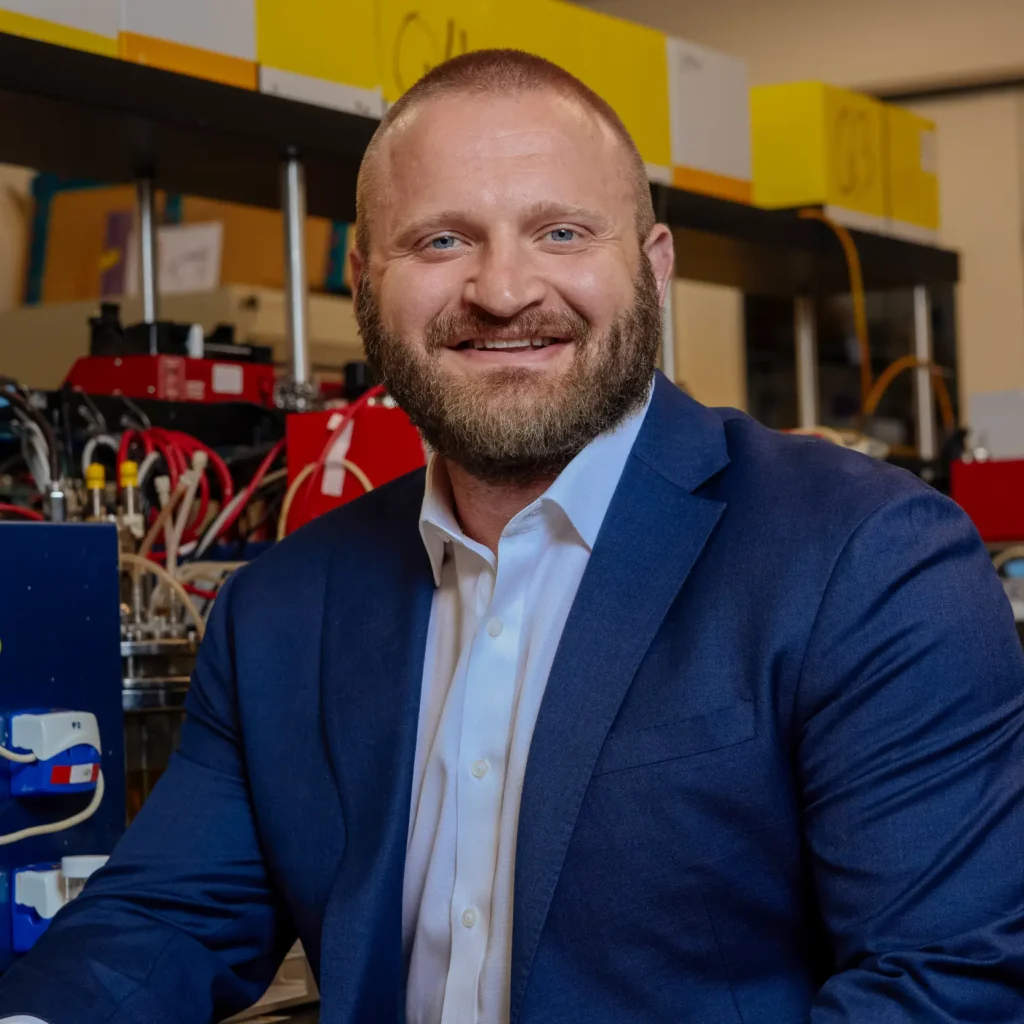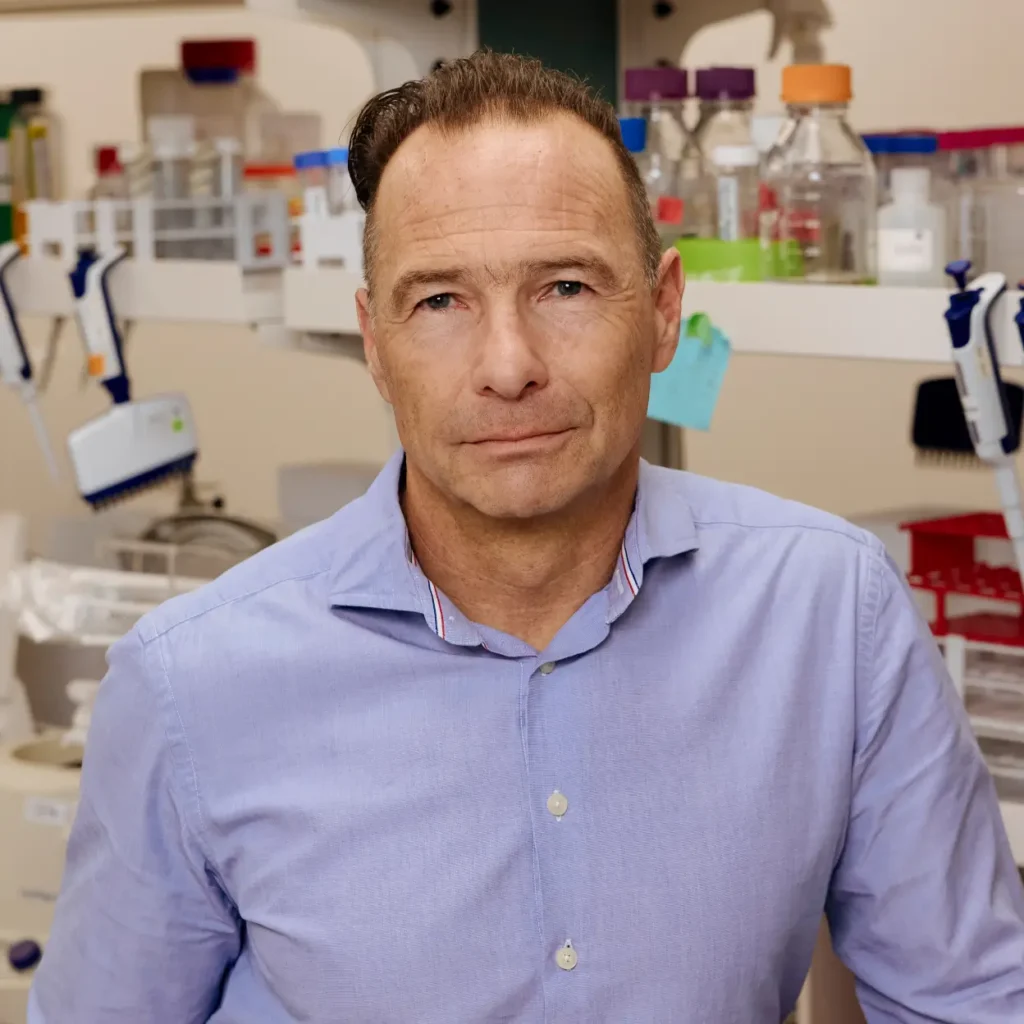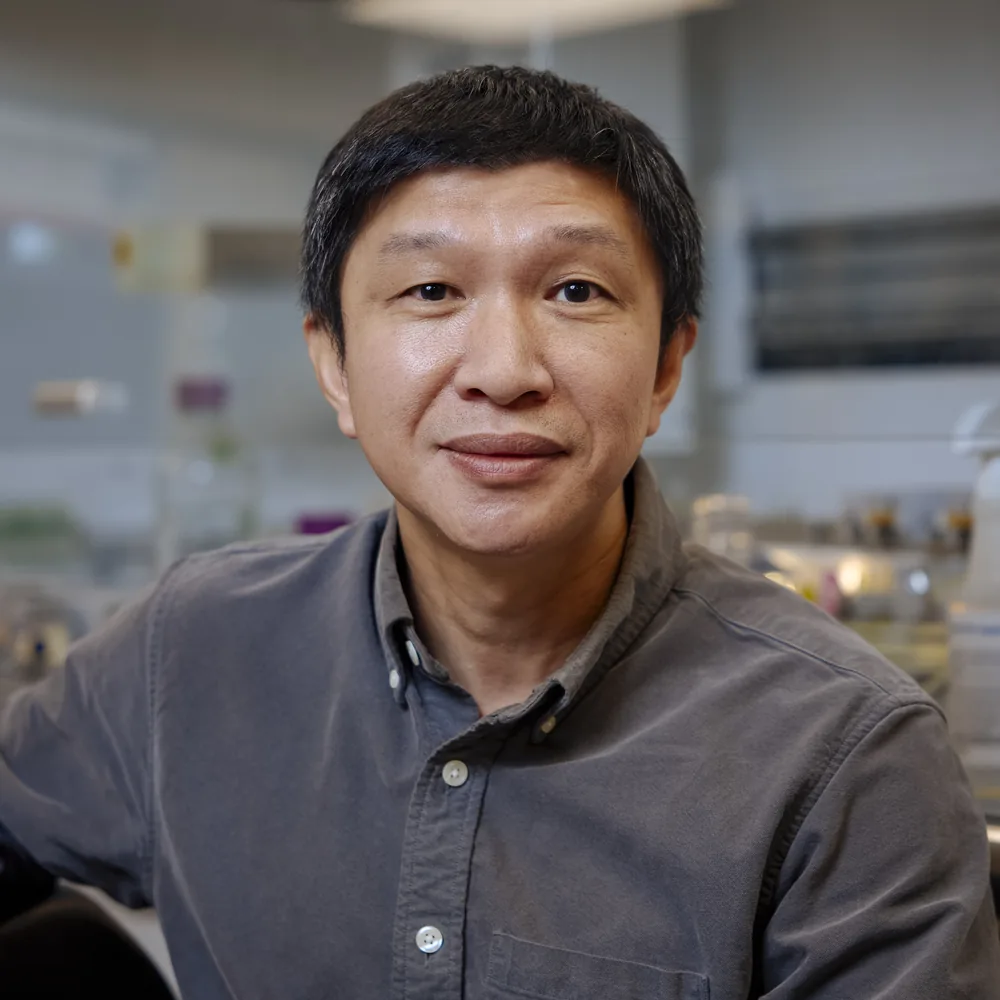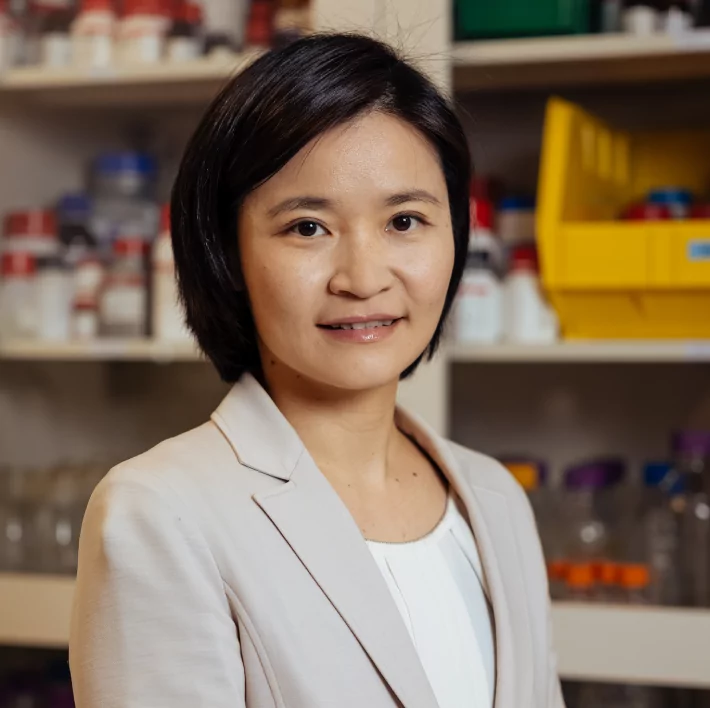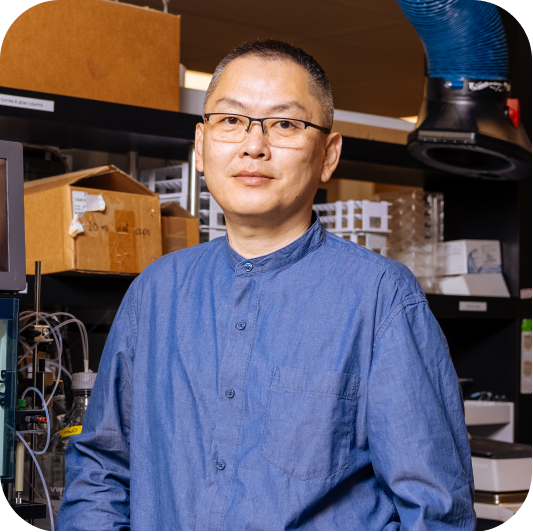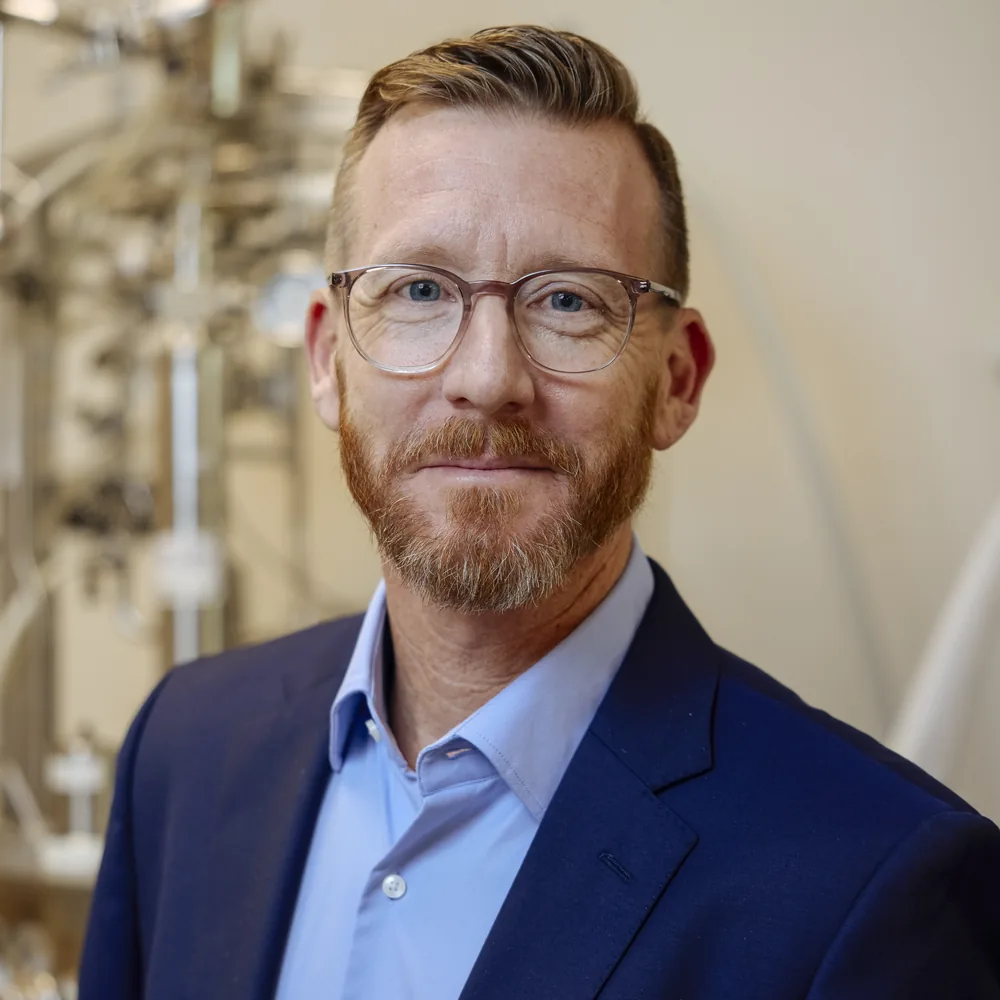
In today’s blog, we are pleased to introduce Andrew Saarni, Head of Fermentation Process Development & Scale-Up at Antheia. Andrew brings deep expertise in precision fermentation and large-scale manufacturing to help Antheia produce essential medicines more efficiently and reliably than ever before. We sat down with Andrew to learn more about his journey into the fermentation field and what excites him about the work ahead.
Tell us about your background and career journey. How did you get into fermentation?
I went to UC Berkeley as a bioengineering major and by the time I graduated, I wasn’t sure what exactly I planned to do with the degree. In 2012, I stumbled upon a company called Genomatica (now Geno) and applied for a Fermentation Associate I position. I joined not knowing much about fermentation beyond having brewed a beer or two, and I got incredibly lucky. Geno had a particularly strong emphasis on precision and beginning with the end in mind, neither of which were adequately appreciated in the industry at the time. Shortly after I joined, we built a brand-new lab designed entirely around high-precision, high-throughput fermentation. I was running 8-12 tanks each week and the project I was working on was on the cusp of being transferred to a manufacturing partner in Europe. Within two years of starting my career, I was supporting international scale-up and tech transfer! My time at Geno effectively gave me a world-class, hands-on fermentation education. I had wonderful mentors and the fermentation fundamentals I learned from this time are still what I rely on today.
In 2016, I ended up going back to school at UC Davis for a master’s degree in chemical engineering. During grad school I did a business development internship back at Geno, which was interesting, but I kept sneaking peeks at the fermentation data and quickly realized that I preferred the technical side. After graduating, I returned to Geno as a fermentation engineer, and that’s when I got even deeper into tech transfer and scale-up. When I rejoined, we were kicking off a multimillion-dollar project to design a greenfield manufacturing plant in Iowa that is now officially built and operating. I served as the fermentation lead on the small team that authored the Process Design Package (PDP) for that plant. That project is where I fully internalized the phrase “begin with the end in mind.” We always knew where we were going in terms of scale, so everything we did was designed with that target in mind — running representative experiments that simulated what the process would look like at full scale, identifying any deficits, and addressing them through strain or process engineering.
After Geno, I went on to lead the fermentation team at Geltor, a Bay Area company making proteins via fermentation primarily for beauty and personal care products. There, I got to design and build a new, high-precision fermentation lab from scratch and lead a stellar team who ran up to 40 bioreactors per week efficiently and with very high precision. We also successfully scaled up eight unique protein products for overseas manufacturing. Those experiences — thoughtful scale-up, designing high-precision, high-performing labs, and leading teams — are what really shaped how I think about building and scaling fermentation operations, and they’re directly informing how I approach my work at Antheia today.
What attracted you to Antheia?
Back at UC Berkeley, one of my senior projects was a theoretical design for engineering yeast to produce thebaine, codeine, and morphine. My TA told me it involved far too much metabolic engineering and therefore wasn’t feasible. I came across Antheia’s job posting on LinkedIn and thought, “that’s what I was thinking about ten years ago!” Zack McGahey reached out about my current role, I interviewed, and the rest is history. I had done some due diligence in advance, but I hadn’t fully appreciated how far along Antheia actually was – they had already commercialized a product that was working well.
What made me say “yes” was the team. Everyone I interviewed with seemed like an A-player, and I had tremendous confidence in Antheia’s outlook coming out of those conversations. It’s also just a fascinating class of products to pursue. These molecules are essentially intractable through traditional synthetic chemistry. You have to rely on biology to make them, and it’s the exact kind of role I wanted. I’m still genuinely impressed that we have a yeast with over 30 heterologous genes that produces commercially viable titers of our products while still being metabolically robust. That’s a huge engineering accomplishment on the strain side, and it’s something I don’t take for granted.
What are your primary responsibilities as Head of Fermentation Process Development & Scale-Up?
My work straddles two main areas. The first is our pre-pilot platform with smaller 20-40 liter fermentors. The primary function of that platform is to produce representative fermentation broth, reproducibly and with high precision, so our downstream processing team can develop and validate the purification processes. The other purpose is to run fermentations that closely simulate the at-scale environment, using more representative feedstocks like bulk corn syrup instead of lab-grade powders, running under pressure, and testing the kinds of scenarios we’d encounter at a commercial facility. I’m focused on improving how that platform runs, making it more precise, automated, and capable.
The second part of my role is what I jokingly refer to as the “keyboard commando” side: tech transfer and scale-up. Last year, we started onboarding a new contract development and manufacturing (CDMO) partner — a company called TAPI that has manufacturing sites in Europe. In this context, my role involves writing documentation, interfacing with the TAPI team, and designing or adapting our processes to fit their facility (or in some cases, designing or adapting aspects of their facility to fit our processes).
When I’m onsite at TAPI, we’ll sit down with their technical teams and work through everything: how do we streamline a process that may have started as a lab protocol but now needs to run like clockwork, in a more cost-effective way, with shift-based operators following a paper batch record? How do we optimize our medium recipes to achieve manufacturing cost targets? How do we combine solutions, optimize feeding dynamics, address potential oxygen-transfer and cooling capacity limitations, and reduce the number of moving parts without sacrificing performance? It’s really about asking: will this process fit as-is? If not, what needs to change? And once it fits, how do we make it as simple, robust, and cost effective as possible?
What hot topics or business trends are you following?
Bioprocessing has a particular version of a problem that affects a lot of industries: we run thousands of fermentations per year, each generating an enormous amount of valuable data. What often happens is that data is top of mind for a few weeks after an experiment concludes, and then it ends up in a database, sometimes fragmented across different places, and typically isn’t meaningfully revisited. There are now companies offering data integration solutions that make all of that data much more accessible and comparable. We’re also actively working on internal tooling for the same purpose.
But what really excites me is the next layer: what we used to call machine learning and now typically call AI. A human can’t meaningfully parse through thousands of runs of fermentation data. But we’re at a point now where AI tools are robust enough to be applied to large datasets in a continuous way, and there’s a tremendous amount of insight locked up in data that’s been sitting on a metaphorical dusty shelf. Ben Kotopka, our head of data science, has built great internal tools, and he and I are working on some proof-of-concept experiments applying AI to bioprocesses. I’m cautiously optimistic. The industry has spent a lot of money generating this data, and for it not to be used in a continuous, active way is a real missed opportunity, but I’m confident we’ll get there.
Where do you see Antheia’s greatest opportunities?
Antheia is disrupting a market that has been established for over a century — it isn’t going anywhere and has significant supply chain vulnerabilities that need real solutions. That’s the right kind of business case, and it’s a big reason I was excited to join. We’ve already demonstrated we can produce thebaine at commercial scale and as we continue to scale our manufacturing capabilities, I think Antheia is positioned to become the industry standard.
Our people are another major strength. Across R&D, operations, commercialization, and finance, we have world-class experts who are fully committed to the mission. That combination of talent and purpose is what will enable us to transform pharma supply chains and lead real change in the industry.
What do you hope to achieve at Antheia in the next year and in the next five years?
In the near term, it’s all about efficiency and precision. As we begin to scale and launch additional products, we’ll need to find more ways to increase our efficiency – this is where I can add value. In the next year, I’m focused on adding more automation and technical capabilities to gain stronger, data-driven insights into our process to improve our performance, tech-transfer efficiency, and ultimately, our time to market.
One example: In my first month here, I tracked down a mass spectrometer for off-gas analysis for a great price, got it into our lab, connected it to all 61 of our bioreactors, and now I’m working to integrate the data with our bioreactor control software across all of our platforms. Off-gas analysis lets you measure how the yeast is “breathing” — oxygen uptake and carbon-dioxide evolution — noninvasively and in real time, which gives you a continuous, live window into metabolism. With that capability, we can gain key insights that were previously hidden to us and develop our fermentation processes in a much more automated, feedback-driven way. Enabling off-gas analysis augments the value of each bioreactor in a truly transformative way – it’s a big upgrade!
In five years, I’d love to look back and know that I played a meaningful role in scaling Antheia’s platform to reliably supply the essential medicines that society depends on. When I think about what was only theoretical in my senior project at UC Berkeley back in 2011, and see where Antheia actually is today, it’s surreal. I can’t wait to see where we go from here.
What makes Antheia a great place to work?
Everyone is genuinely friendly, and that matters. We have a great lab, a strong technical team, fantastic leadership, and investors who are fully bought in. And I would be remiss not to mention: the snack wall is exceptional; I’ve never seen anything like it.
Tell us about your life outside of work.
I’m a “hybrid athlete,” which in my definition means I’m not as strong as I look and have better cardio than you’d expect. I’ve been lifting weights since high school and during COVID I got heavily into indoor rowing and cycling. Exercise is genuinely therapeutic for me. If I’m not doing it, stress hits harder and everything is just a bit less enjoyable. The Bay Area is also great for hiking, especially up in the hills, so I take advantage of that whenever I can.
My family has a vineyard in Sonoma, so in the fall, my wife and I go up to pick grapes, crush, and bottle wine. We also got married there last September (the seventh family wedding under the grand “Wedding Oak”). We have two dogs: Hamilton, a four-year-old cavapoo and his younger brother, Mango, a one-year-old cavapoo who’s considerably feistier. They are very good boys. We cook a lot at home — I primarily handle the grilling and the dishwashing — and when time allows, I like to play PC games.
Is there anything else you’d like to share?
Antheia is the place to be, and we’re going to the moon.
Follow Antheia on LinkedIn.