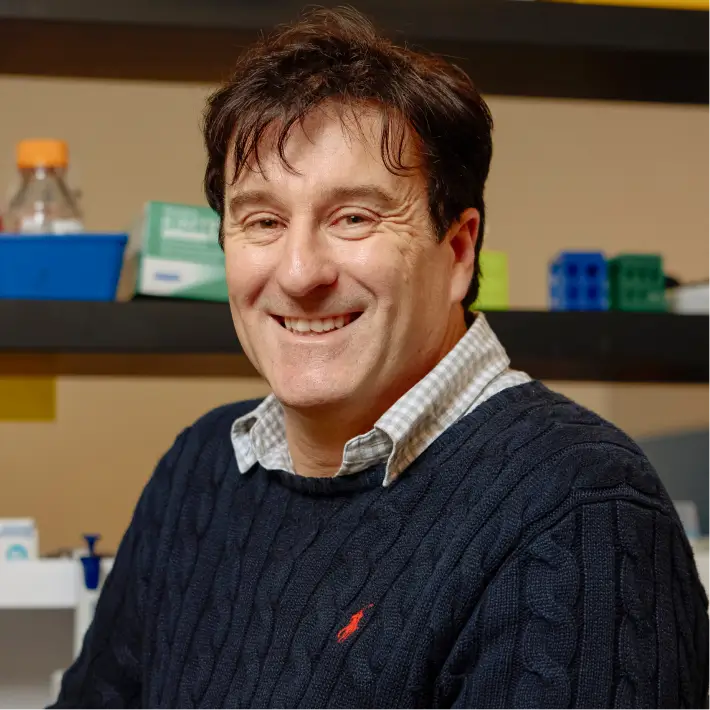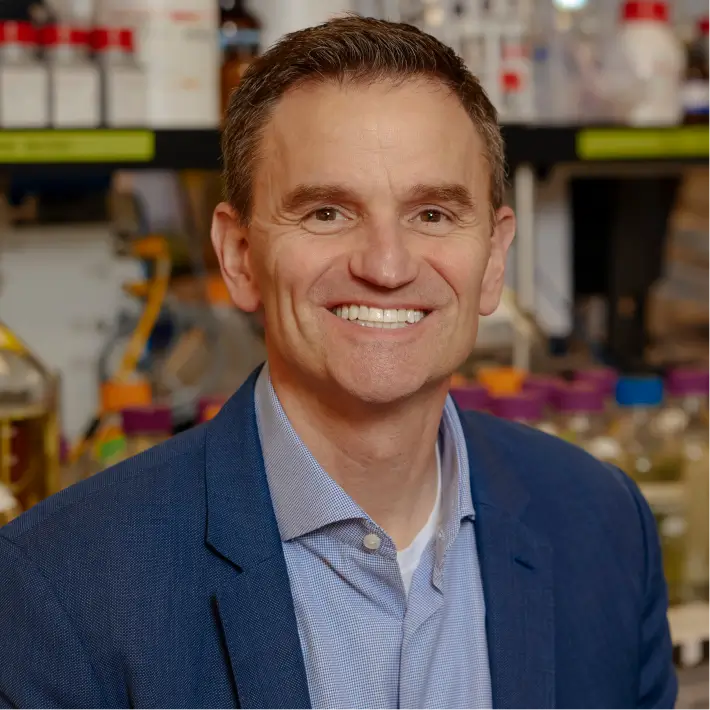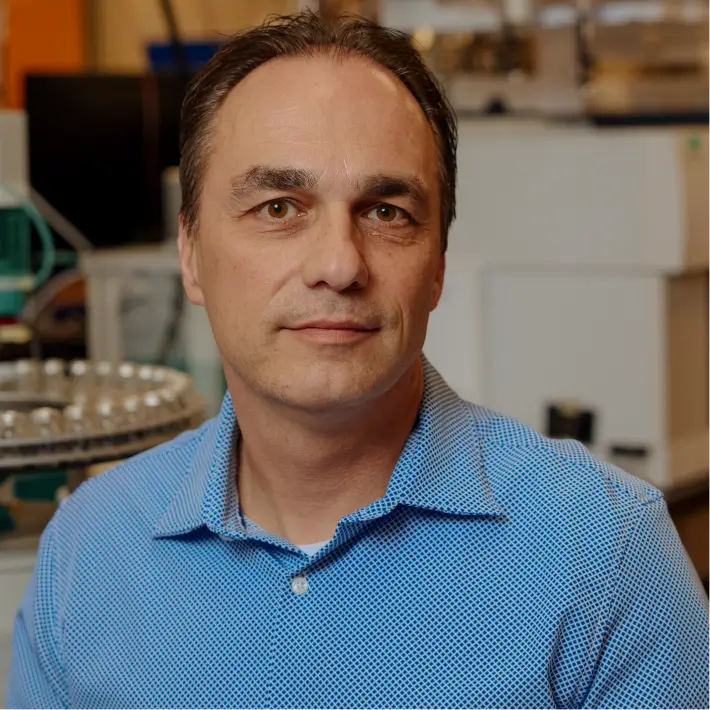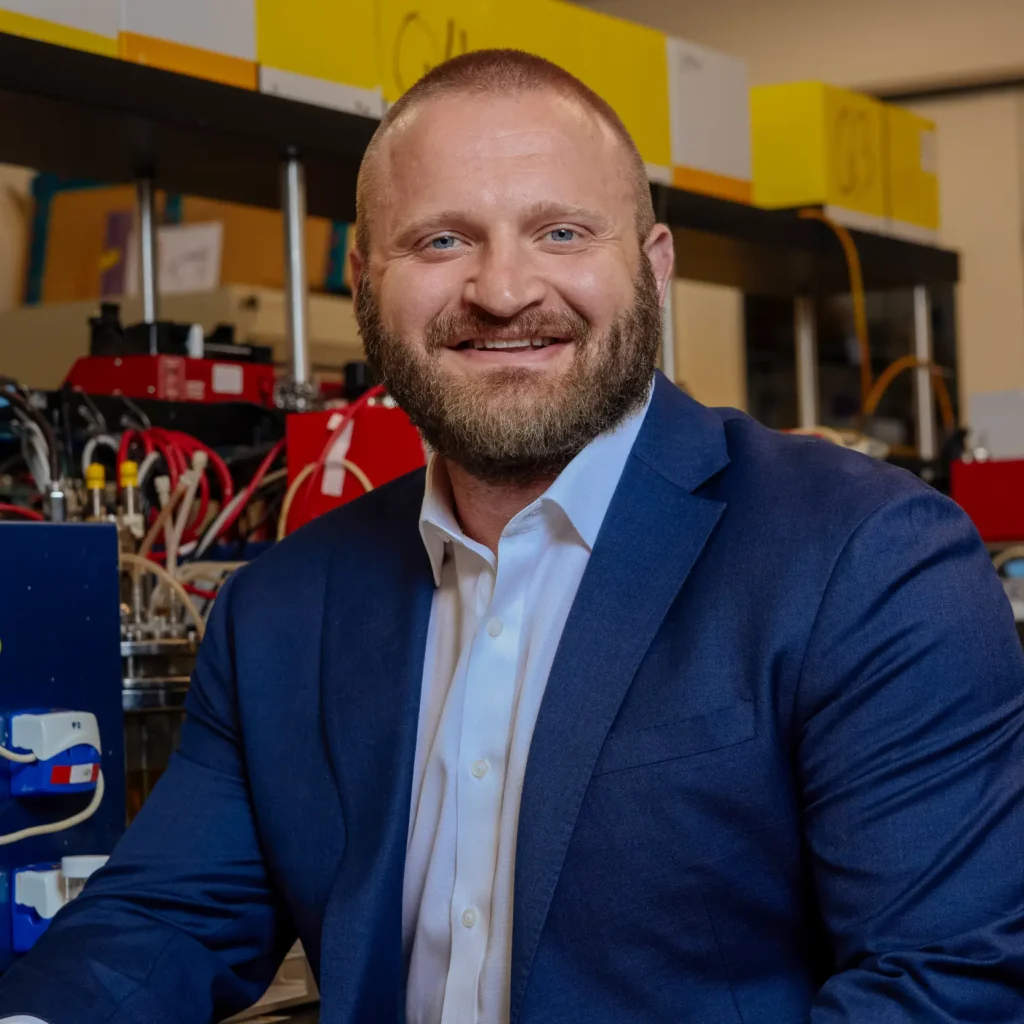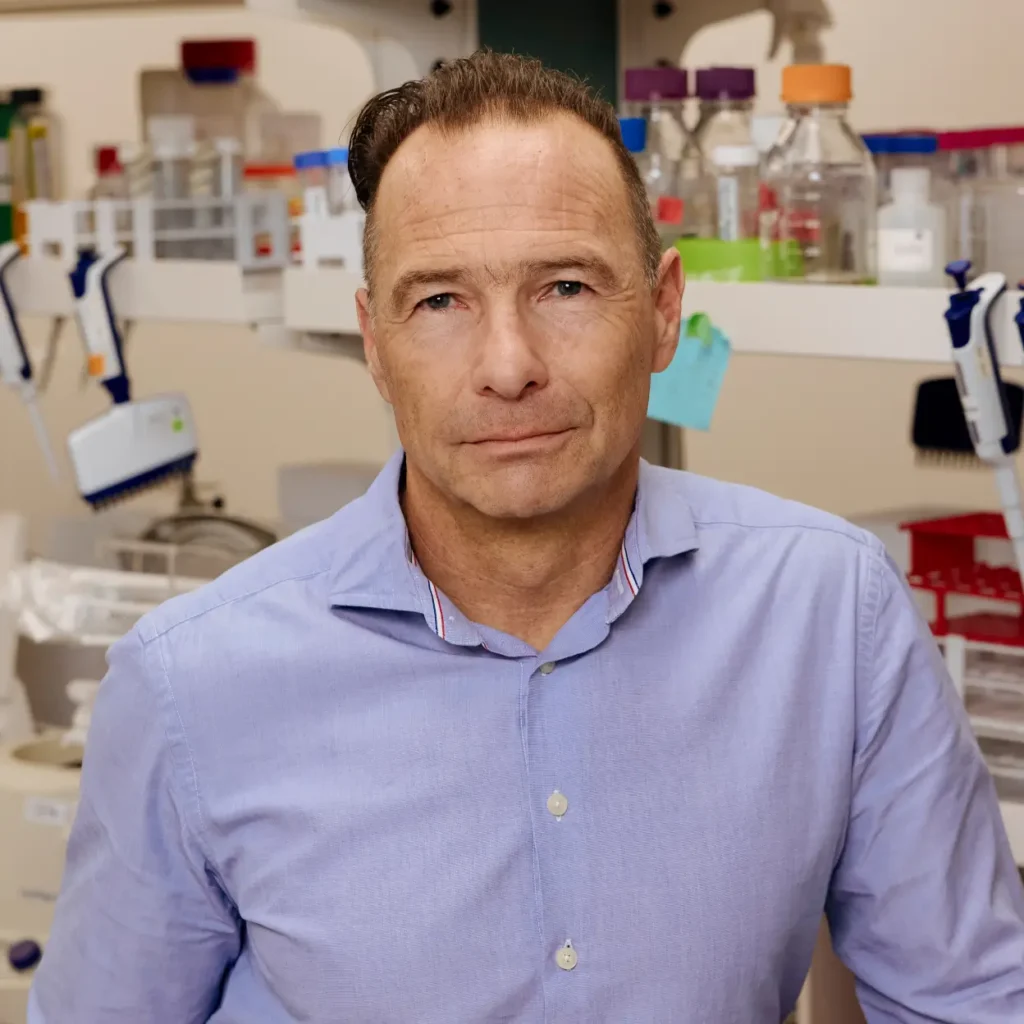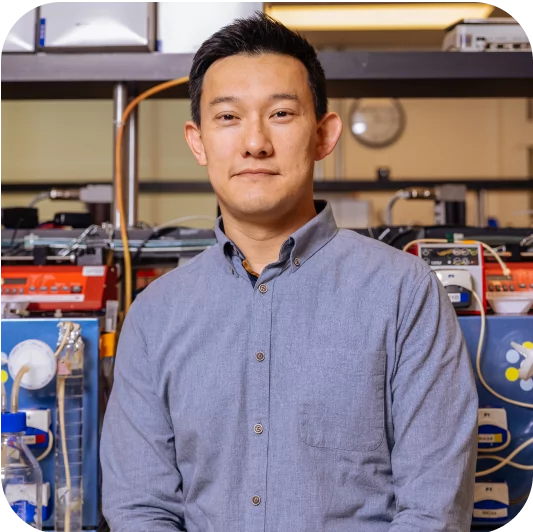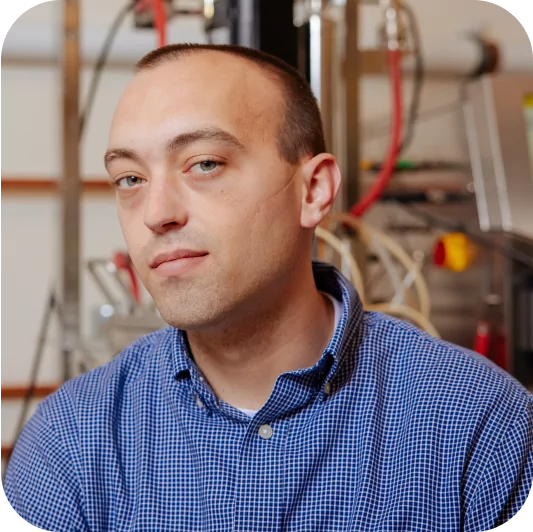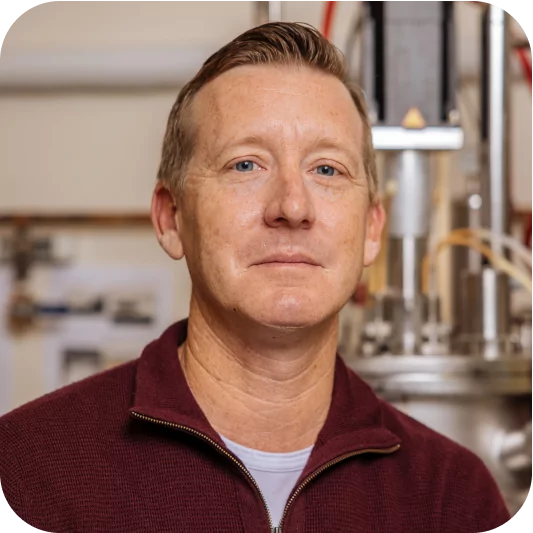
In today’s blog, we are pleased to introduce Adam Takos, Vice President of Drug Innovation and Managing Director of Singapore. Adam brings more than two decades of experience in plant biochemistry, yeast metabolic engineering, and drug discovery to his role, having built scientific programs at companies across Australia, Europe, and the United States. We sat down with Adam to learn more about his path to Antheia and what he’s building in Singapore.
Tell us about your background and career journey. How did you get into drug discovery and innovation?
My background doesn’t look like a typical launchpad for a drug discovery career. I’m an applied plant biochemist from Australia, with a PhD from Flinders University. Like most scientists, I was driven by curiosity and a genuine desire to discover something new.
Looking back, my career has been shaped by a series of stepping stones that led to the next opportunity. Important publications consistently unlocked my next professional milestones. A major paper from my doctoral work secured my first role engineering E. coli at a local synthetic biology company. I then returned to plant research for a postdoc at CSIRO Plant Industry’s world-renowned lab at the Waite Campus in Adelaide, where another well-received paper served as the direct springboard to the University of Copenhagen. During my eight years there as an associate professor, I came across Christina Smolke’s landmark work on alkaloid engineering in yeast. I was reading her papers closely and trying to pursue similar work myself. I uncovered some really fundamental discoveries about how these pathways evolve, and it gave me a deep understanding of the plant side of the pathways that we now engineer in yeast at Antheia.
In Denmark, I honed my knowledge and skills in yeast engineering at Evolva before joining SNIPR Biome in Denmark. I was drawn to SNIPR by the chance to develop life-saving medicines with its unique CRISPR platform. This was my entry point into drug discovery. The team was extremely focused and we got to Phase 1 trials in just a few years. This experience brought me to Ginkgo Bioworks in Boston where I led a $30 million portfolio, including drug discovery and large yeast metabolic engineering programs.
I joined Antheia this year after paternity leave and it feels like coming full circle. I had an interest in trying to engineer yeast to produce alkaloids way back during my Copenhagen years, so returning to that work through Antheia is very fulfilling.
What are you taking from those past experiences into your work at Antheia?
On the technical side, the yeast metabolic engineering fundamentals I developed throughout my career still apply ten years later. I was very active at the bench until about four or five years ago and I still intend to be involved with our technical work in Singapore. This is important to me, and it can have a significant impact, both for staying connected to the work and the team.
SNIPR Biome is also particularly relevant to what I’m doing now. When I joined SNIPR, I was employee number four or five, and we were setting up a lab from scratch. That’s exactly what I’ve been doing here in Singapore for the last several months. A lot of the experience of building something from the ground up has been directly applicable.
In addition to learning from the technical challenges, I was exposed to many different leadership styles, organizational structures, and ways of working. Synthesizing the best of all those experiences is my goal at Antheia.
What attracted you to Antheia? What made you say yes?
When I started looking for a new role after my son was born, I already knew of Antheia and was excited by Christina’s work. What really attracted me is where Antheia is today as a company. We’re no longer talking about potential — this is a company that has already realized a great deal of it. Antheia has scaled and commercialized its first product, with customers. It has cleared a hurdle that so many companies never get over, so that’s a huge part of the appeal. It’s the kind of company I would have liked to have started myself so it’s very exciting to be part of the team today.
Then there’s the team. When I interviewed, I was struck by how down-to-earth and personable everyone was. I remember asking Ken a question about what makes Antheia and its platform unique, and he talked about the quality of the team. He didn’t mention great processes or AI or machinery. He talked about people. That resonated with me.
The Singapore opportunity was also a big draw for me personally. My family is still in Adelaide, and Singapore is only a six-hour direct flight from home. I recently popped over for a weekend visit, which I never could have done in any of my previous roles.
What are your primary responsibilities as VP of Drug Innovation and Singapore Site Manager?
The core of the role is to fill our pipeline with new target molecules: building programs that will follow what we already have in production to create additional commercial opportunities.
Part of the mandate in an innovation role is to push the boundaries. In this role, I’m working to extend our platform capabilities into new host strains and tools we haven’t used before. Singapore’s biotech ecosystem gives us a unique opportunity to tap into a different talent pool and draw on perspectives and ideas we might not have encountered otherwise. The role also involves managing the site: overseeing the team, program planning and execution, performance management, and making sure the facility operates with good processes, lab practices, and IP capture. I want to develop a strong culture here, one where people aren’t afraid to fail or to try something new. If you’re always doing comfortable things, you’re probably not trying hard enough. And after having lived and worked in four countries, I know from experience that you can do your job very effectively and still have a good life outside of work. I intend to foster that for our team.
What does a typical day look like for you, and what is your vision for the Singapore site as it grows?
The first few months have been dominated by a few big priorities. Recruiting has been huge. We’re primarily looking for strain engineers — people with strong capabilities in metabolic engineering, gene editing, CRISPR, and high-throughput screening. But beyond technical skills, we’re a small team, so I’m looking for self-starters who have a strong sense of ownership and are not afraid of uncharted territory. I’m glad to say we have three great hires coming on board very soon.
Championing biosynthesis technology locally and advancing the field here is another key element of my role, so I’ve also been engaging deeply with the Singapore Economic Development Board (EDB) and A*STAR, Singapore’s lead public sector R&D agency. Both teams have been extremely supportive and invaluable in helping us access capabilities that would have taken a long time to build from scratch. They’re also helping facilitate collaborations with local research groups and supporting our new hire onboarding.
Then there’s the lab itself: equipment procurement, vendor onboarding, safety and compliance protocols. I’ve also been squeezing in some bench work, including cloning experiments to get a few things ready for when the full team arrives.
Once the setup phase is behind us, the priority will shift to managing the team and programs, maintaining a strong technical overview, and continuing to refine our strategy. That means aligning with our partners, and working closely with Kristy and Chris at HQ to make sure our work in Singapore fits coherently into Antheia’s global strategy. I’ll also be keeping an eye out for new partnership opportunities as our programs mature.
As far as the vision, I believe innovation always has to live within the constraints of a sound business case. I’ve seen companies where the technical ambition and the commercial logic don’t line up, and it rarely ends well. Kristy, Chris, and I have had a lot of conversations about exactly this — making sure we’re going after programs with a strong commercial footing, not just technically interesting ones. That balance of rigor and ambition is key.
What makes Singapore an attractive place to live and work?
Professionally, it’s a unique place. There’s very strong government momentum behind biotech here — in some ways, it reminds me of Denmark, where I lived for many years. Both are small countries with remarkably green economies that are genuinely forward-thinking and supported by long-term government investment. That creates a different talent pool: diverse, global, and full of perspectives I haven’t encountered before.
As a city, Singapore is spectacular. Architecturally stunning, remarkably modern, yet with a real sense of history. It’s extremely safe, the food culture is extraordinary, and it feels like a gateway to Asia in a way that’s hard to describe until you’re here.
Where do you see Antheia’s greatest opportunities — in the next year, and in the next five?
In the near term, we’re focused on scaling the molecules we already have in the pipeline. We’re staying true to our mission of making medicines with vulnerable supply chains more accessible.
The five-year view for Antheia is even more exciting. Pharma has walked away from a lot of molecules over the past few decades, not because they lacked promise, but because they were simply too difficult or too costly to source and manufacture at scale. Biosynthesis can unlock a new chapter of drug discovery by making those abandoned molecules viable again. Molecules that were left on the shelf can come back into play because now, we can actually make them.
Tell us about your life outside of work.
I have a young son who just started walking! My partner is Brazilian; they’re both in Brazil right now and will be joining me here later in the year, with plans to travel back and forth.
Beyond family, mountain biking is a genuine passion. In Denmark, it was part of daily life. It’s meditative for me in a way that very little else is. I also love to travel. I’ve driven road trips up and down the West Coast of the U.S. to the Grand Canyon, competed in mountain bike races in Colorado, and explored much of Europe during my years there. I just started beginner Kendo classes here in Singapore, and when I’m in Brazil, I try to get some kite surfing in — I’ve gotten to the point where I can stay up on the board for a stretch, which I’ll take as progress.
Follow Antheia on LinkedIn.