This article was authored by CEO and co-founder Dr. Christina Smolke and originally published on LinkedIn.
The past few years have brought a renewed focus on pharmaceutical supply chain resilience in the U.S. While some progress has been made, there are still over 200 active drug shortages and more than 90% are long-standing with an average duration of over four years. Atropine, epinephrine, lidocaine — drugs used every day in pediatric surgery, oncology, and emergency care — have been in shortage for a decade or more. The human impact is measurable, and the need for a solution is urgent.
The reason for these shortages is structural, and it starts well before a pill is made. Most generic medicines depend on key starting materials (KSMs) and active pharmaceutical ingredients (APIs) produced almost entirely overseas, primarily from China. Much of that production relies on outdated manufacturing approaches that are slow, highly variable, geographically constrained, and hard to relocate. The U.S.-China Economic and Security Review Commission has documented the result: the U.S. can no longer domestically produce KSMs and APIs for some of the most basic medicines. The disruptions vary — logistics failures, geopolitical tensions, natural disasters, quality issues — but the outcome is the same: Americans struggling to access medicines they depend on.
Onshoring existing and outdated manufacturing technologies to the U.S. is not the answer. What’s needed is next-generation technology that can compete on cost and time, and provide resilient, agile, and distributed production of critical medicines. The solution is American-born innovation: advanced biosynthesis and biomanufacturing.
Supply chain resilience can’t be built on legacy infrastructure
The existing manufacturing infrastructure in the U.S. operates well below capacity, but is wholly inadequate for solving our most urgent supply chain challenges. Current domestic capacity is concentrated in fill finish and drug formulation, but KSMs and APIs – the foundational ingredients from which all drugs are made – are sourced almost entirely abroad because we don’t have the infrastructure to produce them here. That gap has been filled almost entirely by foreign suppliers. U.S. Pharmacopeia found that China alone supplies 41% of the KSMs that reach U.S. patients and is the sole producer of at least one KSM for nearly 700 critical medicines. These starting materials are routinely the chokepoint in domestic pharmaceutical manufacturing, underscoring that the national security risk increases as you go further upstream.
Compounding the problem, the infrastructure that could be used to produce KSMs and APIs is outdated. It is not equipped for the advanced manufacturing technologies that would make onshore production of these pharmaceutical ingredients not only possible, but economically viable.
In 2020, my company, Antheia, began searching for a manufacturing partner to produce a key ingredient used in Narcan, an overdose rescue drug. We pursued several domestic leads, but none could accommodate our technical processes, capacity requirements, and timelines. To scale, we ultimately had to take our processes to Europe, where we launched our first commercial product. I have heard countless versions of this story from other founders across the industry. American-born innovation keeps leaving American soil because the infrastructure to scale it doesn’t yet exist.
Antheia’s advanced biosynthesis platform is the most promising path to building end-to-end, domestic supply chains for our most critical medicines. This American-developed technology uses engineered microorganisms, rather than agriculture or chemical synthesis, to produce KSMs and APIs, unlocking faster production timelines and competitive pricing. Because it is not bound to specific geographies or specialty inputs, it provides unprecedented supply chain surety, agility, and rapid-response production that legacy manufacturing cannot. Strategic investment in advanced biomanufacturing infrastructure will enable the U.S. to secure vulnerable supply chains and regain global leadership in critical technologies.
Strong early signals, and an opportunity to build on them
The federal government has moved in the right direction. In August 2025, President Trump signed Executive Order 14336, directing the Administration for Strategic Preparedness and Response (ASPR) within HHS to fill the Strategic Active Pharmaceutical Ingredients Reserve with APIs for roughly 26 medicines deemed critical to national health and security. The order’s focus on KSMs and APIs is correct: this is where our supply chain vulnerability is most acute.
Through its BioMaP-Consortium, ASPR has committed more than $181 million to onshore pharmaceutical production. Antheia and the API Innovation Center are among the selected performers bringing drug substance manufacturing to commercial scale in the U.S. ASPR and DARPA also spearheaded the development of Equip-A-Pharma, a collaboration between federal agencies, universities, and companies to boost domestic manufacturing of key medicines and their APIs. These are strong early examples of public-private partnerships that work.
Advanced biomanufacturing technology transforms the economics of onshoring KSM and API supply chains: it breaks the cost, scale, and geography constraints that have made domestic production uncompetitive for decades. So much so that our internal research estimates the U.S. could become a net exporter of several critical KSMs and APIs in as few as two years. This is a defining example of American Dynamism and early federal investments have validated the importance of this technology as such. Investment at the scale of other strategic national priorities — as the federal government is currently doing with critical minerals and quantum computing — can enable fully domestic supply chains for our country’s most critical medicines.
Why government investment has to lead
Biotech venture capital is recovering after several difficult years. With $33.8 billion deployed across the sector in 2025, we’ve made notable progress as an industry but are still well below the nearly $54B peak in 2021. Furthermore, this capital is largely flowing toward drug discovery and innovation, where the models are more established and better-suited for high-reward potential. The current conditions for domestic KSM and API production in the U.S. do not attract meaningful private investment, but the U.S. government can help change this equation. Government investment helps to kickstart domestic solutions and also signals to private investors that this is a long-term national priority.
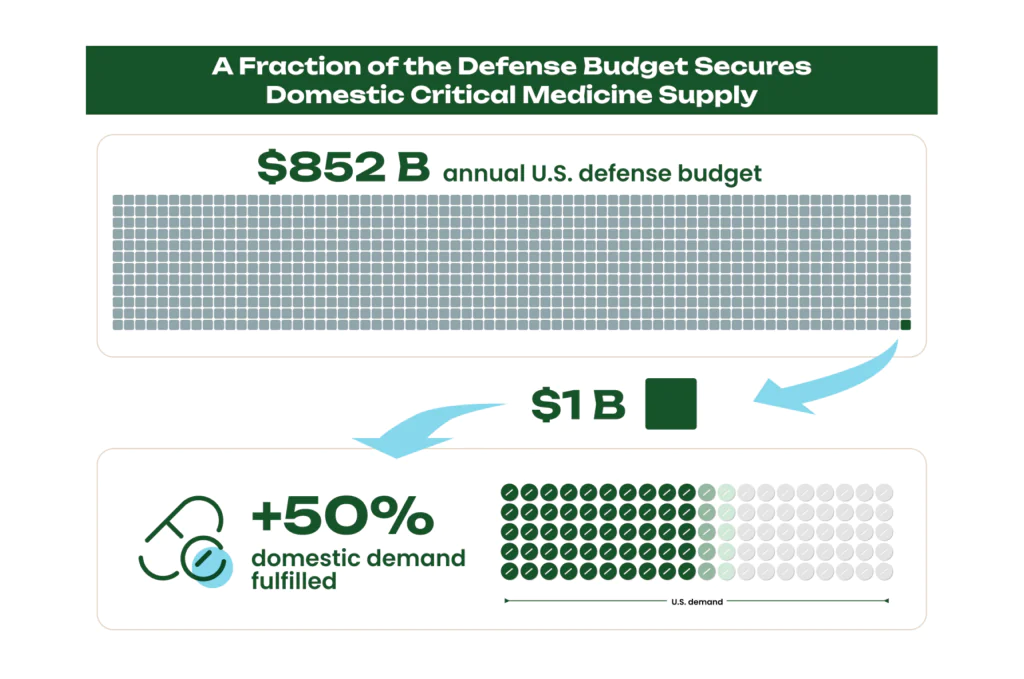
Our research indicates that a $1 billion investment to retrofit existing facilities for advanced biomanufacturing could onshore more than half of the annual U.S. essential medicine demand. The FY2025 defense budget was $852 billion – a meager fraction of this budget would entirely eliminate U.S. dependency on foreign pharmaceutical ingredients and address a long-standing national security vulnerability. This is a one-time investment to cross an economic threshold. Once that infrastructure exists, the technology’s cost and supply advantages not only sustain it but allow the U.S. to reshape critical medicine supply chains globally.
The Administration has established onshoring KSM and API supply chains as an urgent national priority because this is not merely a healthcare issue. Military readiness, pandemic preparedness, and economic stability are all impacted by our foreign dependence on pharmaceutical ingredients. While early funding has begun to materialize, we need to take a whole-of-government approach to fully engage the ecosystem and catalyze private capital at scale.
Building the next generation of resilient critical medicine supply chains in the U.S.
My call to action to policymakers: Direct funding through public-private partnerships to revitalize domestic infrastructure with innovative manufacturing technologies and secure American pharmaceutical supply chains.
Advanced biomanufacturing allows the U.S. to leapfrog the legacy production models that have kept domestic KSM and API manufacturing uncompetitive, rather than trying to replicate outdated methods at home. Government investment in brownfield retrofitting is the fastest path to deploying this technology at scale and building resilient supply chains for KSMs and APIs. We have an opportunity — and a responsibility — to ensure that everyone has reliable access to essential medicines, even in times of disruption. The time to act is now.
The diagnostic work is done, the model is proven, and the manufacturing technology is ready. The political will is growing. What remains is the decision to invest at the scale this national security priority demands.
Follow Antheia on LinkedIn.