In biomanufacturing, the quality of measurement is critical to the scaleup and commercialization process. We spoke with Arlie Lehmkuhler, Scientist II on Antheia’s Analytical Development team, about why precise measurement data is the foundation of a more reliable supply of essential medicine ingredients. Read on for more on the Analytical Development team’s work and what it means for Antheia’s customers, partners, and broader pipeline.
Antheia delivers complex pharmaceutical ingredients to its customers with unprecedented reliability, speed, and consistency that legacy supply chains can’t provide. Living up to that promise requires getting every layer of the process right, including the less visible ones, and the bar for each rises as Antheia further expands its pipeline and scales its commercial production.
One of those layers is analytical development: the work of measuring, precisely and consistently, what the fermentation process actually produces. The substance in the fermentation broth being measured and quantified is referred to as an analyte. Titer – the concentration of a target analyte in each fermentation run – is a key metric for commercial success. Accurate measurement of the target analyte has tangible impact on which strains Antheia scales and ultimately commercializes. The Analytical Development team’s work doesn’t always make the headlines, but it underpins everything Antheia delivers to customers.
From Research to Commercial Scale
Titer drives strategic decisions about which strains to advance, how to optimize the process, and how much product can be sold and delivered to customers. The stakes attached to that measurement increase significantly as a company achieves commercial scale and customer commitments grow.
In academic settings, measurement variability of a few percent is common and workable. As Lehmkuhler puts it: “Despite higher variability in a research setting, that data is still valuable for proof of concept and measuring the cause-and-effect relationships. However, the threshold for variability is much lower if you plan to scale to commercial levels.”
Better measurement at an early stage translates directly into dollars at a commercial scale. Identifying a meaningful change in titer in the development cycle can impact the cost of goods, the amount of product manufactured, and Antheia’s ability to meet its commitments to customers. When measurement variability is too high, a strain that could make more product at lower cost can look indistinguishable from one that can’t. Measurement precision is what allows Antheia to advance its best strains and put them into production.
Isolating Variability
In a fermentation process, variability in your data can come from multiple places: the random variation of biology, the fermentation conditions, or the analytical methods and sample preparation used to measure the output.
Antheia’s Analytical Development team focuses on the measurement and sample preparation. By reducing the variability coming from the measurement side as much as possible, what remains in the data primarily reflects what the strain and fermentation process are actually doing.
The team needs to be able to trust that a small improvement in strain performance is real, not a result affected by how the sample was measured. Antheia’s target is sub-0.5% RSD (relative standard deviation, a standard measure of precision). At this level, tiny improvements become visible and actionable.
When it comes to molecules with complex and long multi-step pathways, strain improvements occur in small increments, so detecting and trusting even the smallest gains is essential. The more precise your measurement method is, the fewer times you need to repeat a test to be sure of what you’re seeing. For a team running dozens of strains simultaneously, that efficiency adds up quickly.
As Lehmkuhler puts it: “If we can minimize the non-random variation at every controllable level, then we can confidently rely on small incremental changes and capture tangible commercial value.” In practice, that means Antheia can identify a better-performing strain earlier, advance it faster, and more reliably deliver product to our customers.
The Core Principles
Achieving that goal starts with how samples are prepared and measured. Two principles are central to Antheia’s approach:
- Internal standard: A known reference compound added to every sample at the start of preparation. As Lehmkuhler describes it, “it’s essentially a tracker inside every sample,” so any variation that occurs to the analyte along the way is captured and corrected for. The right internal standard can help compensate for both random and systematic errors happening during subsequent sample preparation and handling steps, resulting in more precise and accurate quantitation.
- Gravimetric sample preparation: Rather than relying on pipette volumes, Antheia uses gravimetric sample preparation, with every sample weighed to less than 0.1% variation. Measuring by mass with the use of an internal standard is more precise and reproducible. As a result, the reported titer is tied to a more accurate weight measurement rather than a volume measurement, which is subject to more variability from manual pipetting and sample viscosity.
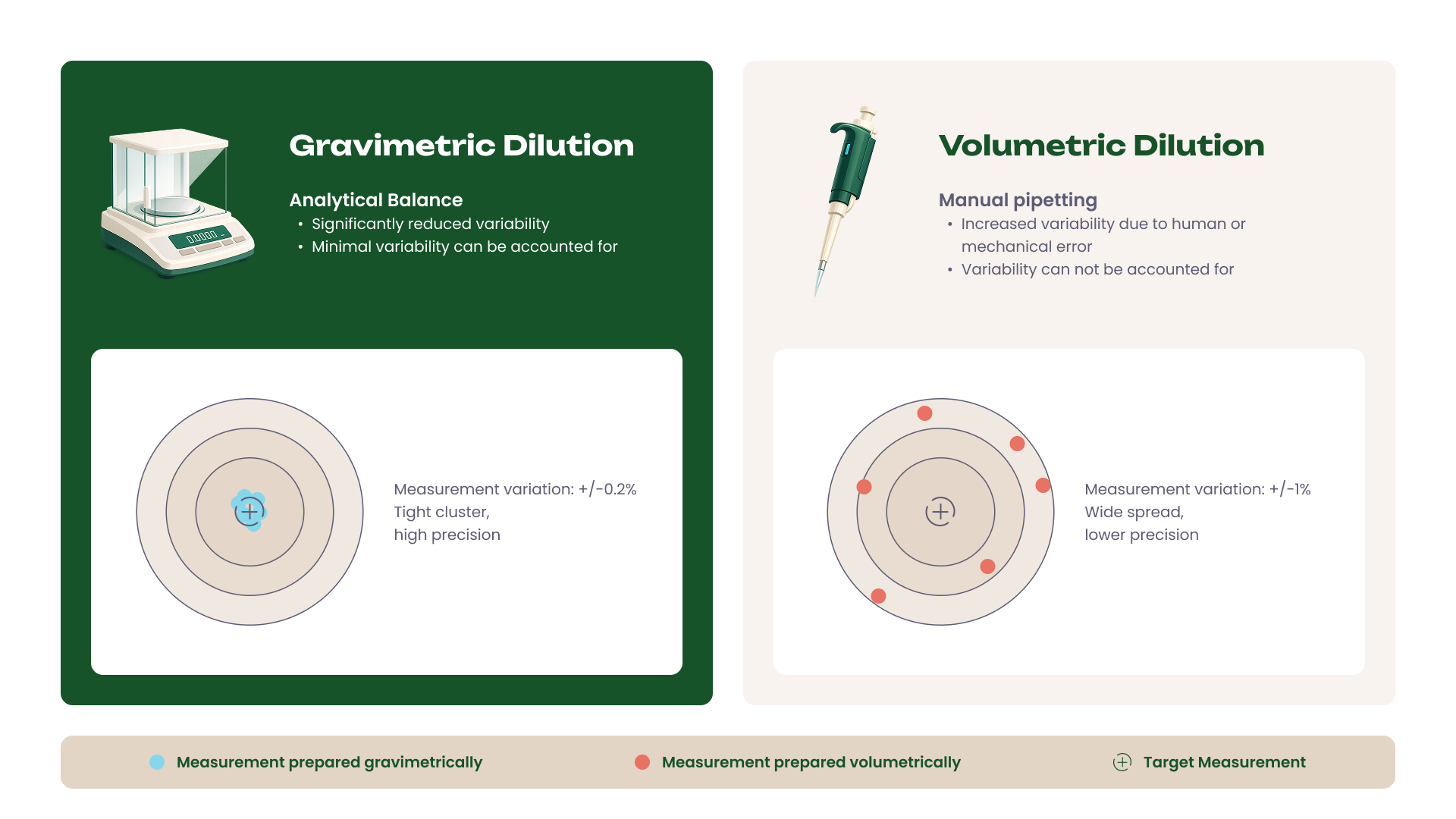
Together, these core principles bring analytical variability down significantly. For thebaine, Antheia’s first commercial product, the results are measurable: analytical variability now sits at 0.3–0.4% RSD, well below the 0.5% target. The same standards are applied across the entire pipeline as Antheia brings new products to market. Tracking method performance over time means that changes in data quality are caught and addressed before they are further scaled and can affect commercial production. The result is a measurement the company can rely on.
Always Improving
There is no single industry standard for analytical development and measurement at the R&D stage. What Antheia has built reflects a deliberate choice to apply commercial-grade precision long before it’s required, because the cost of imprecision grows as you scale.
Antheia applies the same data-driven approach to fermentation process variability, examining parameters like temperature and pH to understand how they contribute to titer outcomes from run to run. Optimizing the measurement layer is the first step: when analytical variability is minimal, changes in fermentation data point to their actual source rather than getting lost in measurement noise. That visibility is part of how Antheia delivers on its promise of building more resilient pharmaceutical supply chains.
That same discipline runs through Antheia’s broader operations. The work the Analytical Development team has done reflects how Antheia operates as a commercial-stage company. Bringing its first product to market was the first milestone. Building on that foundation and expanding the portfolio of ingredients Antheia delivers to customers, is the ongoing work.
Follow Antheia on LinkedIn.